
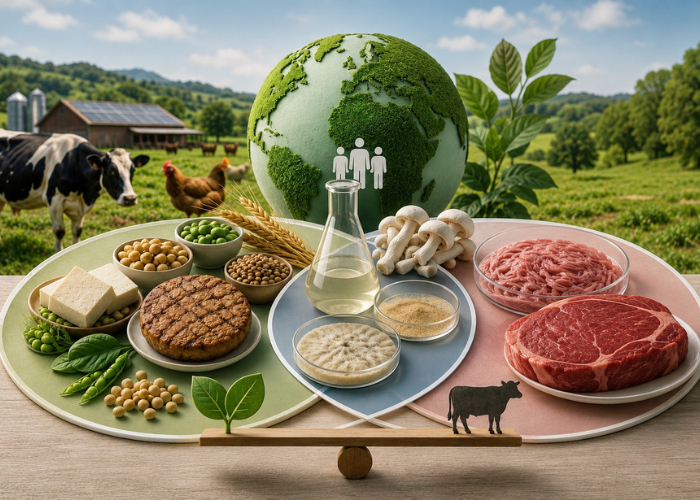
Animal proteins remain at the heart of global food systems, delivering nutrient density, food security, economic value, and deep cultural identity. That’s why the future of protein shouldn’t be framed as replacement, but as protein coexistence. Innovation can expand consumer choice, but it should work alongside livestock supply chains, leveraging complementarities, nutritional quality, real sustainability, and freedom of choice.
Key Messages
- The future of protein is coexistence: sustainable livestock farming and FoodTech innovation can coexist and strengthen each other.
- Food security and global growth: as the population rises and the risk of a “protein crash” increases, complementary proteins are becoming a strategic necessity.
- A new protein balance: plant-based solutions, precision fermentation, and cultivated meat are driving a more diversified, resilient, and customizable protein market.
The Big Picture
The global population surge poses a serious food availability challenge (food demand > food supply) with a food crash projected in 2050 and population reaching 10Bn people. Breaking down at proteins scenario it turns even worse.
With current proteins production trend and demand boost it is predictable a protein crash already in 2030. Those availability challenges are exacerbated by increasing sustainability impact and global hunger constraints, while the geopolitical uncertainty is calling for strict food security policies.
The Complementary Proteins debate should focus on how to leverage the opportunity – and not if – to expand both food availability and food security.
What's At Stake?
Complementary proteins are animal-free alternatives to conventional meat, dairy, fish and eggs designed to match specific business and consumer benchmarks while reducing environmental impact, optimising production and delivering consumers’ value. We focus on three main Complementary Protein production processes, Plant-based, Fermentation-derived, and Cultivated/cell-based, keeping aside Insect-based alternative which would need a specific assessment and is already embraced by many food cultures.
Business Challenge
Food-Tech Startups are the key engine of innovation and disruption in the alternative proteins, moving the industry beyond plant-based offer into cultivated/cell-based and fermentation technologies. While food companies are adding plant-based acquisitions to their portfolio, startups take on the high risk/reward R&D to achieve a business model able to ensure P&L profitability, market scalability and a competitive taste, texture and price vs. animal products.
A smart way to ensure scalability is to focus on animal benchmark marked by premium proposition (eg: rare meat as Wagyu) or scarce offer (eg: protected species as Tuna). This Hi-End positioning can command a premium price that allows to absorb costs and fasten profit.
From a market perspective, Q1/2025 investments into alternative proteins start-ups seems to reward the newest solution which is showing high potential in terms of consumer value and market efficiency; In fact fermentation-based leads at 146M$ with plant-based at 54M$ and cultivated at 35M$.
Consumer Implications
Complementary proteins key challenge is related to consumer perception. In that respect, plant-based is the best perceived proposition given the vegetables intrinsic wholesomeness and an established presence on the market, cultivated/lab-grown reports some rejections in relation to the laboratory non-natural source perception and fermentation being the new proposition has a chance to explains its concept via consumer education and advocacy plans. Beyond consumer perception, three key attributes need to be cracked to move an alternative proteins solution from start-up to operations, they are Taste, Texture and Price.
TASTE & TEXTURE: Plant-based solution (often based on legumes and wheat) has been struggling to reach conventional animal reference. While recent studies show plant-based nuggets at taste parity with animal benchmark, the players operating in this technology are striving to achieve an authentic texture and reduce the bitter or beany off-taste, which may require masking with additives and impacting on less clean labels.
On the opposite side, cell-based technology leverages actual meat cells and generates real meat tissues to deliver the closest taste and texture result to animal specs. Fermentation-based solution capitalizes on microorganisms like fungi or yeast to produce meat-like proteins or fats providing a natural and savoury taste with also a rich ‘umami’ depth that enhances the overall flavour profile. Texture wise this solution also allows a perfect intramuscular fat content delivering an intriguing taste experience.
PRICING: Plant-based solution, with average price offer <10€/kg, lands at the lowest end-pricing, with a price parity or price advantage (mincemeat) vs. conventional meat in major retail markets. Fermentation-based, placed at average price range of 10€-90€/kg, stands at middle ground and is primarily used for high-end ingredients (eg: Heme) or portioned premium meat (eg: Wagyu) rather than whole-cut meat. Cultivated meat, with average price >90€/kg, is the most expensive option due to open cost and scalability challenges.
The End Result
Putting together strategic considerations with business and consumer implications, the three complementary proteins solutions build on distinctive strengths, diverse propositions and specific consumer needs. Given this articulated segmentation and assuming each technology will be working vs. its own challenges, the next coming scenario brings to a market with the presence of different complementary proteins targeting specific consumers and occasions. Those complementary proteins portfolio offer will coexists in integration and synergy with protein farming from livestocks.
This means the consumers (and citizens) will benefit of a broader food choices portfolio that can allow personalized choices while also protecting food system from incumbent geopolitical risks (supply-chain stock outs and food security) as well as food hunger.
Final Reflection
The complementary proteins debate seems driven by emotions and bias rather than factual evidence. The ‘non-livestock-based’ proteins exploitation seems needed as solution to push back strategic challenges like food hunger and food security, within an integrated agrifood strategy with livestock farming.
This is absolutely true for a region like Europe, where European Union policy making is granting the highest global standards of healthiness and wholesomeness in agri-food and animal production. Consistently with this virtuous policy making culture, EU politics is called to define an innovative regulatory framework that will ensure a wide alternative proteins availability with best quality standards and optimal value-for-price equation.
In this way, EU politicians will empower Europe with valuable food choices for citizens while securing regional ambitions in terms of food security and food chain resilience.