
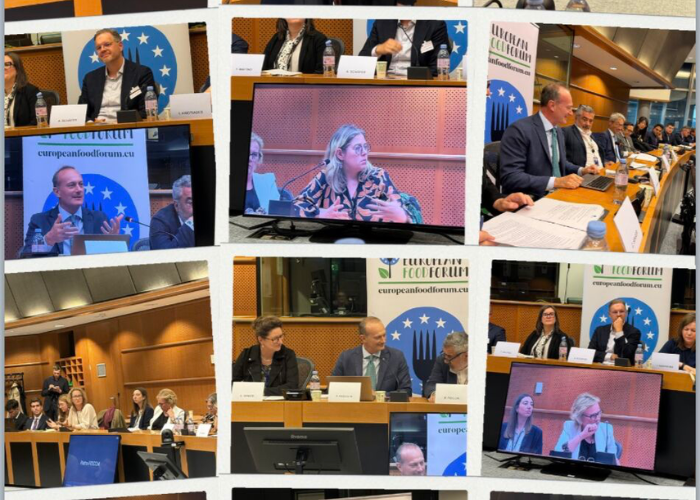
At the European Parliament, we took part in a high-level discussion on the EU Deforestation Regulation (EUDR), organized by the European Food Forum, focused on one of the most critical challenges for European businesses and global supply chains: how to achieve the regulation’s environmental objectives while ensuring legal certainty, proportionality, feasibility, and competitiveness. The event, “The EUDR in Practice – Between Ambition and Feasibility”, hosted by MEP Pietro Fiocchi and MEP Christine Singer, brought together policymakers, industry representatives, and stakeholders to examine the practical implementation challenges of the regulation and the readiness of companies and Member States ahead of upcoming deadlines.
The discussion, moderated by Pietro Paganini, featured contributions from:
- Jay Ceyssens, Deputy Head of Cabinet of Commissioner Jessika Roswall
- Dr. Andreas Schäfer, German Federal Office for Agriculture and Food (BLE)
- Dr. Bartolomeo Filadelfia, ICQRF, Italian Ministry of Agriculture, Food and Forestry Policies
- Dr. Salvatore Alberino, ICQRF, Ministry of Agriculture, Food Sovereignty and Forests
- Ylenia Maitino, Sustainability Public Policy, Director, Ferrero
- Iliana Axiotiades, Secretary General, COCERAL
- Eileen Gordon, Secretary General, European Coffee Federation
The discussion explored the EUDR from different angles, focusing on the role of the European Commission, the readiness of Member States to adopt and enforce the regulation, and the real-world challenges faced by companies and supply chain operators.
Missed the event? You can watch the full recording here.
Key takeaways
- EUDR ambition is widely supported, but implementation remains the real battleground: stakeholders broadly agree on the need to fight deforestation, but major divisions remain over how the regulation can work effectively in practice.
- The European Commission is working to provide guidance, simplification and greater clarity for operators: through updated guidance and the May 4th review, the Commission is trying to make the EUDR more workable while preserving its environmental objectives.
- Member States are preparing, but still face concrete operational challenges: Germany, Italy, and other countries highlighted major operational gaps, particularly around geolocation systems, data flows, and enforcement capacity.
- Small operators risk carrying the heaviest burden: SMEs, small forest owners, and fragmented supply chains face disproportionate administrative and technical challenges under the current framework.
- Legal certainty remains the biggest missing piece: operators across sectors warn that unclear rules, inconsistent interpretation, and unresolved compliance questions are slowing preparation efforts.
- Data governance is becoming a critical pressure point: sensitive data protection, traceability obligations, and geolocation requirements remain among the most complex issues for implementation
- Some companies are already building EUDR best practices: operators are advancing compliance systems and working within coalition-based approaches to accelerate readiness.
- Other sectors warn the system is not operationally ready: industry groups stressed that key systems, guidance, and harmonization measures are still missing.
Overall, one point remains essential: the discussion must also include those who were not physically in the room but are deeply affected by the regulation – producers in origin countries, including smallholders. In many supply chains, they are the first mile of traceability. If implementation becomes too complex or too costly, exclusion becomes a real risk.
The challenge is not to choose between ambition and feasibility. The challenge is to make ambition feasible.
Event Snapshots


