
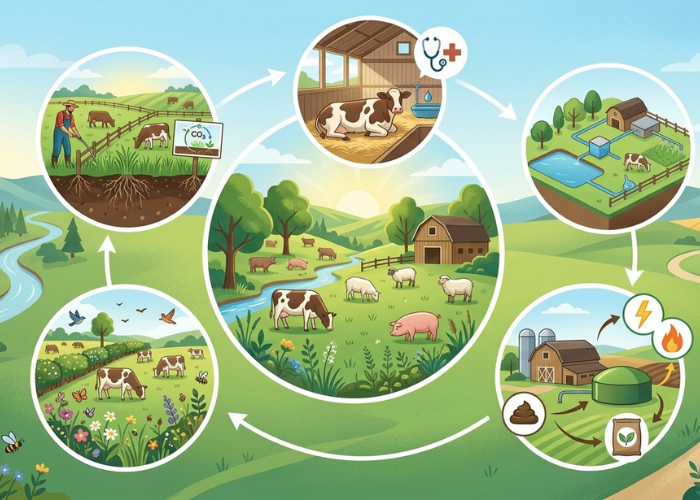
Are animal proteins really the climate’s “number one enemy”? For years, the debate was framed in simple, polarized terms: climate on one side, meat, dairy, and livestock on the other. But today, advanced data, new scientific metrics, artificial intelligence, and satellite monitoring systems are revealing a far more complex reality. The environmental impact of animal-based foods cannot be reduced to a single number that applies everywhere, forever. It depends on how emissions are measured, how food is produced, how farms are managed, how carbon cycles are calculated, the nutritional value of foods, and the technologies available to reduce emissions. Understanding this requires a shift in perspective: from slogans to measurement, from perception to verification, and from ideology to accountability.
Key Messages
- Measure Smarter, Debate Better: the climate impact of meat depends on how we count emissions – and the numbers tell a more complex story than commonly assumed.
- Follow the Evidence, Not the Headlines: new data, satellites, and AI-powered monitoring are revealing that the biggest methane hotspots often lie beyond the farm gate, challenging long-held assumptions.
- From Source to Solution: agriculture is more than an emitter. Through carbon sequestration and innovation, farming has the potential to become part of the climate solution.
Does Meat Really Pollute? It Depends on How We Measure It
For a long time, the answer seemed obvious: yes, meat pollutes. But the real question is: how are we measuring it?
The most widely used model, GWP100, converts all greenhouse gases into CO₂ equivalents over a 100-year timeframe. Under this system, methane appears especially harmful. Yet this metric tends to treat very different gases as if they behaved the same way. CO₂ remains in the atmosphere for centuries, continuously accumulating over time. Methane, by contrast, is a short-lived gas: it breaks down in roughly 10 years and does not accumulate in the same way.
That’s why researchers at the University of Oxford developed GWP*, a metric designed to represent the climate impact of biological methane more realistically. The results are reshaping the debate: according to some simulations applied to Italy, emissions estimates could shift from +206 million tons of CO₂ equivalent under the traditional model to roughly -49 million under GWP*.
The Global Methane Debate: Are We Missing the Bigger Picture?
In the public debate, cows have become the global symbol of methane emissions. But the data tells a far more complex story about where methane really comes from.
A significant share of emissions originates from the energy sector, especially leaks across oil and gas supply chains: largely invisible emissions, yet extremely concentrated. At the same time, landfills and urban waste management are among the fastest-growing methane sources worldwide.
This doesn’t diminish the role of agriculture, but it does put it into context. Especially because livestock farming itself is already undergoing a major transformation.
Precision feeding, genetic selection, and new technologies are already helping reduce emissions per animal in measurable ways. Multiple studies show that innovative feed additives – including yeasts, tannins, essential oils, and compounds such as 3-NOP – can cut enteric methane emissions by 10% to over 30%, while also improving productivity and animal welfare.
At the same time, manure management is becoming an energy opportunity: methane can now be captured and converted into biogas, supporting renewable energy production while reducing overall emissions.
AI and Climate: The Shift From Narratives to Numbers
The real paradigm shift is not just scientific, it’s technological. Artificial intelligence, satellites, and advanced monitoring systems are transforming the way we observe environmental impact.
New technologies can now detect emissions in real time, map previously invisible sources, and correct inaccurate estimates. According to data from TROPOMI, the Tropospheric Monitoring Instrument satellite system, emissions in cities are between 1.4 and 2.6 times higher than previously estimated, while landfills may account for up to 50% of total methane emissions.
In the livestock sector, the adoption of sensors, predictive algorithms, and precision farming technologies is making it possible to monitor consumption, emissions, and production performance with an unprecedented level of detail.
This does not mean denying the environmental impact of animal proteins. It means measuring it more accurately, understanding it in context, and recognizing that not all production systems, gases, technologies, or outcomes are the same.
The real challenge is not choosing sides, but improving the way we observe reality. AI, data, satellite monitoring, and scientific research can help move the conversation beyond abstract blame and rigid narratives.
Because only better data can lead to smarter policies, more targeted innovation, and truly responsible choices. The goal is not to declare war on meat, but to use science and technology to improve production systems, reduce real-world impacts, and recognize the nutritional, economic, and cultural value of animal proteins.
Read La carne inquina davvero? Dati alla mano, cosa c’è da sapere >>>