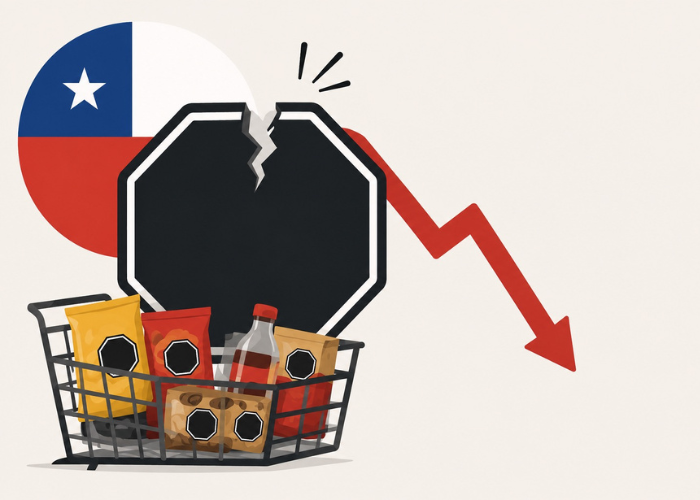
The Lancet study on Chile’s food warning labels has been widely celebrated as proof that front-of-pack warning labels ‘work.’ But does the evidence really support such strong conclusions? A closer look at the data suggests a far more limited, context-specific, and politically amplified result than many public narratives imply.
We have reviewed the recent Lancet study “The impact of Chile’s multipronged food labelling and advertising law on early childhood excess weight” by Guillermo Paraje et al. on Chile’s food warning labels and found that the conclusions being promoted publicly appear significantly stronger than the evidence presented in the paper itself. While the study has been widely described as proof that warning labels ‘work,’ we believe the findings require a more cautious, balanced, and evidence-based interpretation.
Explore key policy takeaways and perspectives shared by experts in nutrition, obesity, metabolism, food science, and public health: download it now.

Key Messages
- The study does not prove that warning labels alone reduce obesity: the research evaluates a broader package of measures, including warning labels, advertising restrictions, and school food rules, making it impossible to isolate the specific impact of warning labels themselves.
- The health impact observed is limited: the study reports only a small estimated reduction in calorie intake (16.4 kcal per day) and a modest short-term effect in children aged 4–6, without evidence of long-term reductions in obesity or chronic diseases.
- The future of nutrition policy should move beyond one-size-fits-all warning labels: smarter prevention tools based on education, health literacy, personalization, digital technologies, AI-driven solutions, and informed consumer choice can offer more effective and sustainable long-term approaches.
The Study Everyone Is Sharing – But Few Are Reading
The Lancet study by Guillermo Paraje et al. has rapidly become a global reference for advocates of warning labels and restrictive food policies. Media outlets, advocacy networks, and public health campaigns are already presenting the Chilean model as evidence that front-of-pack warning labels successfully reduce childhood obesity.
However, the study itself tells a more complicated story.
The research does not evaluate warning labels in isolation, but an entire regulatory package combining warning labels, advertising restrictions directed at children, school sales limitations, and product reformulation measures.
Even the authors acknowledge that it is impossible to isolate the specific effect of warning labels themselves.
A Statistically Significant Effect – But Is It a Real Policy Breakthrough?
The paper identifies a statistically significant reduction in excess weight among children aged 4–6 years. Yet the observed impact remains quantitatively modest and linked to an estimated reduction of only around 16.4 kcal per capita per day.
At the same time, Chile continues to face very high levels of childhood obesity and overweight. The study does not demonstrate long-term reductions in obesity, diabetes, cardiovascular diseases, or broader population health outcomes. It also shows no statistically significant effects in rural areas or among more vulnerable social groups.
The central policy question therefore becomes unavoidable: should limited and highly contextual results automatically justify restrictive regulatory models on a global scale?
From Warning Labels to Smarter Prevention
The study does not close the debate on warning labels, it reopens it. Rather than proving the definitive success of the Chilean model, the evidence highlights the risks of transforming a limited and context-specific result into a global justification for restrictive nutrition policies.
The real challenge for policymakers is no longer multiplying warning labels, restrictions, or standardized scoring systems. It is building smarter and more effective prevention strategies capable of genuinely improving long-term public health outcomes.
In an era increasingly shaped by AI, personalization, and digital technologies, obesity and non-communicable diseases require more sophisticated tools than one-size-fits-all warning systems. Education, health literacy, personalized prevention, physical activity, digital health tools, and informed consumer choice are likely to play a far more central role in the future of nutrition policy.